


How Far Should You Increase Hammer Weight?
The practical limit of hammer mass in the FX DRS system
When a PCP rifle is running a higher regulator pressure or a heavier slug and no longer opens the valve sufficiently, fitting a heavier hammer weight can seem like the obvious answer.
For a while, it may be. The valve may open farther or remain open longer, and projectile velocity may rise. From there it is easy to assume that if a few extra grams helped, even more mass must deliver even more power.
That is where the problem begins.
Hammer mass is not an energy source. The spring stores and delivers the mechanical energy; hammer mass changes the speed, momentum and timing with which that energy reaches the valve.
So the target is not the heaviest hammer possible. It is the lightest moving mass that will still do the required job reliably in that particular system.
What the spring actually contributes
For an ideal linear spring, the energy at a given compression is:
E = ½kx²
where \(k\) is the spring rate and \(x\) is the compression.
In a working rifle, the energy available to accelerate the hammer is not determined simply by the spring's free length. It depends on the difference in spring energy between the cocked position and the point of impact. Relevant factors include:
- spring rate;
- installed preload;
- additional compression created while cocking;
- the distance available to accelerate the hammer;
- friction; and
- how much load remains in the spring at impact.
Free length, wire diameter and coil count alone do not reliably tell us how much energy a spring transfers in operation. A force-versus-travel curve, or at least the spring rate together with the actual installed and cocked dimensions, would be needed. The free length of a 55.6 mm tuning spring is therefore not enough to calculate a physically defensible “optimal hammer weight”.
An extra gram is not free energy
In the DRS, the removable weight insert is not the only part that moves. The insert travels together with the hammer body, so the rigidly moving mass is the sum of both.
What was measured?
To avoid relying solely on catalogue figures, several parts were weighed separately.
A brief note on the measurements: These are individual workshop measurements documented in photographs. The Momert digital scale displayed 0.1 g resolution; this is not a verified accuracy specification, and the figures are not laboratory-certified measurements.
| Part examined | Photographed reading | Rigid hammer mass with the 18.3 g body |
|---|---|---|
| Hammer v7 hammer body | 18.3 g | – |
| Weight insert examined | 12.0 g | 30.3 g |
| Weight insert examined | 13.3 g | 31.6 g |
| Custom-made brass-coloured weight insert | 14.4 g | 32.7 g |
A separate photograph of the tuning spring showed 5.7 g. One assembled combination read 37.2 g on the scale. That is close to the sum of 18.3 + 13.3 + 5.7 = 37.3 g, but the full spring mass must not simply be added to the rigid impact mass: different parts of the spring move at different speeds during operation.
If the same spring delivers approximately the same energy over the same travel, a heavier hammer reaches the valve more slowly:
v = √(2E/m)
In the same ideal approximation, its momentum is:
p = mv = √(2mE)
The difference between a total hammer mass of 31.6 g and 32.7 g is 1.1 g, or approximately 3.5%. With equal spring energy transferred, that would increase momentum by only about 1.7%, while impact speed would fall by roughly 1.7%.
This is deliberately a simple, idealised approximation. In a real impact, contact time, rebound, the hammer and valve springs, pressure and friction all influence how the valve opens and how long it remains open.
The extra 1.1 g therefore does not create a large new amount of impact energy by itself. If a substantial change is seen in projectile velocity or air consumption, the more likely explanation is that valve behaviour has crossed a sensitive transition region.
Why can the valve still react so strongly?
When it opens, the valve must work against pressure-derived closing force, the valve spring, the elastic resistance of sealing elements and friction. The hammer must first set that closing system in motion.
If the strike is insufficient, the valve barely lifts from its seat. A slightly greater impulse, however, may open it meaningfully. Valve lift and open time—the dwell—can then change quickly.
The large change is not necessarily caused directly by one extra gram. That small increase may instead push the valve onto a steeper part of its opening curve.
Domingo Tavella’s PCP model treats the hammer, hammer spring, valve, valve spring, pressure source, air volume, transfer port, barrel and projectile as a coupled system. It also addresses hammer rebound after the first strike and the possibility of a second valve strike. This is a 2018 engineering preprint, not a DRS-specific measurement and not peer-reviewed DRS evidence, so it is useful as background explanation only. Domingo Tavella: Internal Ballistics of PCP Airguns
The point where most of the gain is simply more air use
A larger valve opening may initially deliver more useful air behind the projectile. That can make sense with higher regulator pressure, a longer barrel or a heavier slug.
But the rest of the system also imposes limits. Keeping the valve open longer cannot overcome a restriction once the transfer port, the air path around the probe, the barrel entry, or the barrel–projectile relationship itself limits the available mass flow.
Projectile position in the barrel also matters. Air that arrives late has progressively less opportunity to accelerate it. If the valve remains meaningfully open after the projectile has left the barrel, the air that follows no longer increases projectile energy.
This is where the power plateau appears:
- chronograph velocity rises only marginally;
- air used per shot may increase;
- the shot count per fill may fall;
- muzzle pressure and noise may increase; and
- hammer and valve rebound behaviour may change.
Using measurements and curves, Bob Sterne shows that after hammer strike is increased, projectile velocity can reach a plateau while the longer valve opening continues to waste air. For regulated PCPs, his article regards operation around the “knee” of that curve as a useful power-efficiency compromise. This is not a DRS-specific limit; it is an operating principle illustrated on other PCP systems. Bob Sterne: Using Hammer Strike to Control PCP Power
A Pyramyd AIR guest article presents curves for an FX Panthera valve at different pressures and hammer-spring settings. In the example shown, beyond a certain point a stronger strike mainly kept the valve open longer while the projectile had already left the barrel. It is useful background material, but not an independent scientific study. About PCPs and Tuning: Part Two
What did two Panthera MK1 cases show?
In the cited FX drawing versions, the DRS AR and Panthera list several key hammer and valve components under the same part numbers. These include the Hammer v7 (19039), Hammer Weight (11540), 52 mm hammer spring (2604), Valve Seat (20923), Valve Pin (20924), Valve Seal (20926), and valve spring (19850). The surrounding valve housing is not identical, and shared part numbers do not establish universal compatibility across every version and production year. FX DRS AR drawing, 18 February 2025 · FX Panthera drawing, 2023
Two personally known FX Panthera MK1 rifles used the same combination:
- a 14.4 g custom-made hammer weight;
- a tuning spring; and
- approximately 160–165 bar regulator pressure.
Together with the 18.3 g hammer body, the 14.4 g insert represented a moving hammer mass of 32.7 g.
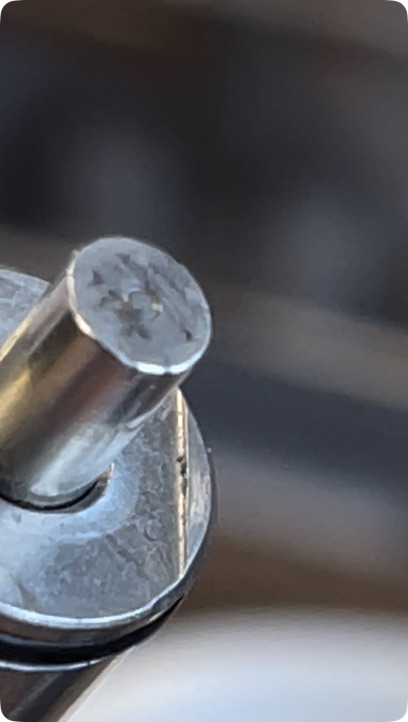
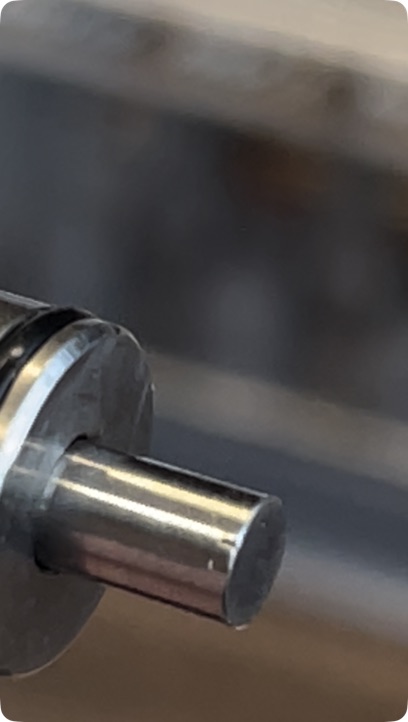
In one photograph, clear plastic deformation and mushrooming are visible on the hammer-side end of the valve pin. The other photograph also shows the struck end, although the extent of damage is harder to judge there.
It would be easy to state simply that “the 14.4 g weight caused the damage.” The two cases do not prove that on their own. Higher mass, a tuning spring, approximately 160–165 bar regulator pressure and repeated impact loading were all present at the same time.
The visible deformation is consistent with substantial, combined impact loading, but the available evidence does not let us separate the contribution of each factor. The photographs also cannot establish whether the block or valve seat was geometrically distorted, or exactly what process led to leakage.
The 14.4 g figure therefore cannot be treated as a danger threshold for every Panthera or DRS. The narrower—and for that reason more credible—lesson is this: in these two Panthera MK1 rifles, the combination of a 14.4 g custom weight, a tuning spring and approximately 160–165 bar pressure was present when valve-pin damage occurred.
What is a tungsten hammer weight for?
Tungsten is much denser than steel, allowing more mass to be installed in the same space.
FX’s official information associates its tungsten hammer weight with slugs that require higher pressure and with longer 700–800 mm barrels. The manufacturer also states that conventional pellets are not expected to benefit. The current product page lists compatibility with the Impact, Maverick, Wildcat MkIII, Dreamline, Crown and Panthera; it does not list the DRS. FX: Tungsten Hammer Weights
The existence of a factory product does not prove that the heaviest possible weight is beneficial in every system. Tungsten is neither inherently good nor bad: it can make sense when the higher valve opening or longer dwell can actually be used by the pressure, air path, barrel and projectile.
Can one ideal gram value be defined?
In short: no.
Different hammer masses may be appropriate for different calibres, barrel lengths, regulator pressures and projectiles. The mass that gives maximum projectile energy is not necessarily the mass that gives the best air efficiency or the most acceptable long-term mechanical loading.
To determine an optimal mass theoretically, at least the following would be needed:
- the hammer spring’s force-versus-travel curve;
- actual preload and cocking travel;
- hammer velocity immediately before impact;
- dynamic valve lift and dwell;
- the impact rebound coefficient;
- the real pressure-derived closing force;
- material data for the valve seat and valve pin;
- mass-flow limits of the air passages; and
- internal-ballistic data for the barrel and projectile.
Some of this is not known without controlled laboratory measurement.
Without it, a single upper gram value recommended for every DRS would be guesswork rather than an engineering result.
The useful operating range of one specific configuration can, however, be measured. The target is not the greatest mass that will physically fit; it is the lowest mass that:
- reliably reaches the desired projectile energy;
- does not consume unnecessary air;
- is not excessively sensitive to small operating variations; and
- does not show signs of valve overdrive or mechanical overload.
The useful upper range starts to run out when the next mass increment no longer produces a projectile-energy increase beyond measurement uncertainty, while air used per shot or mechanical loading continues to rise.
A short chronograph series, of course, does not establish long-term mechanical safety. That would require durability testing, an adequate shot count, repeated dimensional inspection, material analysis or manufacturer limits.
The takeaway
A heavier hammer can help at higher pressure, with a longer barrel or when using heavy slugs. But increasing mass does not create new energy, and it cannot replace tuning the system as a whole.
Beyond a certain point, the projectile gains very little while the rifle may consume more air. If added mass is paired with a stronger spring and greater preload, loading on the valve pin and valve seat may also change unfavourably.
So the right question is not: how much weight can still be made to fit?
It is this:
What is the lowest hammer mass that will still do the necessary work reliably in this particular DRS?
Anything beyond that must prove, by measurement, that it produces genuinely useful additional projectile energy. If it only consumes more air, increases noise or loads the valve more heavily, it is not a true performance gain.

